OCC - Elevation Profile, Aid Stations and Cutoffs
- Orsières, Switzerland
- 60 km
- 3,500 m D+
- 9 aid stations
Map, checkpoints and cutoffs Map · checkpoints · forecast opens Aug 17 Race-day forecast is live
Race-day conditions
Weather, daylight and your arrival time at all 11 checkpoints, set to the 08:15 start.
- Start
- 08:15
- Daylight at the start
- 06:44-20:22
- Aid stations
- 9
Course profile
Orsières, Switzerland
- Distance
- 60 km Finishes 120 m higher than it starts
- Elevation
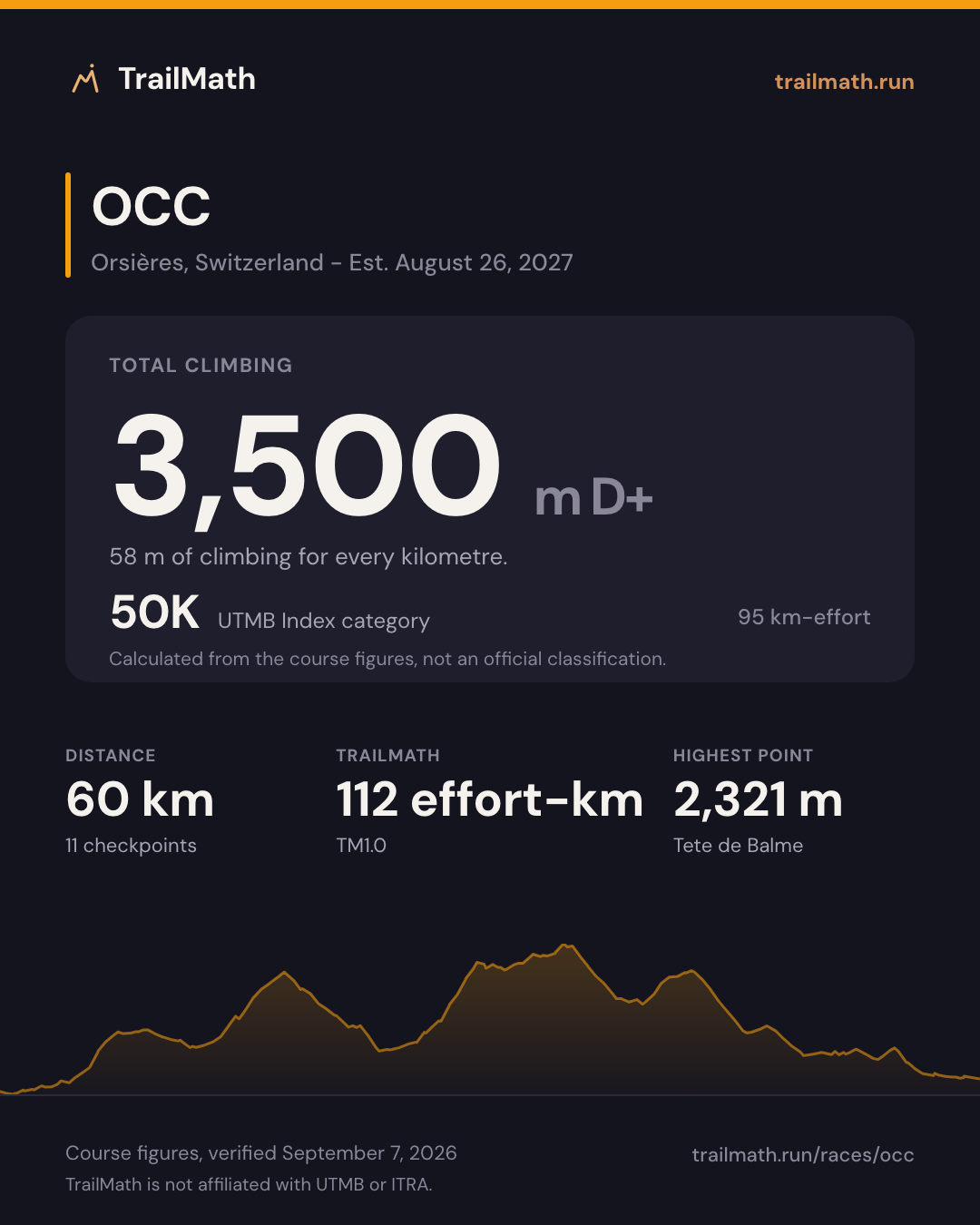
- +3,500 m -3,380 m About 58 m of climb per km
- Highest point
- 2,321 m Tete de Balme
Next edition Est. Thu 26 Aug 2027
Our estimate for Thu 26 Aug 2027. The organiser has not announced the date for this race yet.
- Start
- Winner ~5h 5h after the start
- Median finisher 2026 median 11h23 after the start
- Sunset 12h09 after the start
- Cutoff 15h15 after the start
The OCC (Orsieres-Champex-Chamonix) is a 60km ultra-trail with around 3,500m of elevation gain, running from Orsieres in Switzerland to Chamonix in France during UTMB week. The overall cutoff is 15 hours 15 minutes, and the highest point of the redesigned 2026 course is the Tete de Balme at 2,321m.
The race starts in Orsieres on a Thursday at 08:15 and follows a redesigned course: after Champex-Lac and Trient it climbs to the Col de Balme, crosses the new high point at the Tete de Balme, then passes the Col des Posettes before descending via Le Tour and Argentiere to the finish in Chamonix. Crew access is possible at Champex-Lac, La Giete, Trient, Le Tour, and Argentiere.
Data is approximate and courses change between editions - always verify against the official race guide.
Other distances at UTMB Mont-Blanc
| Race | Distance | D+ | Cutoff | Next start |
|---|---|---|---|---|
| UTMB Mont-Blanc | 174 km | 10,000 m | 45h45 | Aug 27, 2027 (est.) |
| TDS | 148 km | 9,300 m | 44h55 | Aug 23, 2027 (est.) |
| CCC | 107.8 km | 6,200 m | 28h30 | Aug 27, 2027 (est.) |
| OCC (this page) | 60 km | 3,500 m | 15h15 | Aug 26, 2027 (est.) |
Plan against the cutoffs
Enter a goal finish time and see estimated arrivals vs checkpoint cutoffs.
Estimate your finish
One Strava connection reads your last 90 days and estimates your finish on this course. Free, no plan needed.


Course math
Four numbers worked out from this course's distance, elevation and checkpoints.
TrailMath effort-km
112 effort-km
About 11 h for a mid-pack finisher (index 500). Not a pacing guarantee.
Distance + gain ÷ 100 + loss ÷ 200, beside ITRA's gain-only km-effort. Model TM1.0.
How TrailMath works →UTMB Index category
50K
95 km-effort (distance + gain ÷ 100). Calculated from the course figures, not an official classification.
Estimate your UTMB Index →Biggest climb section
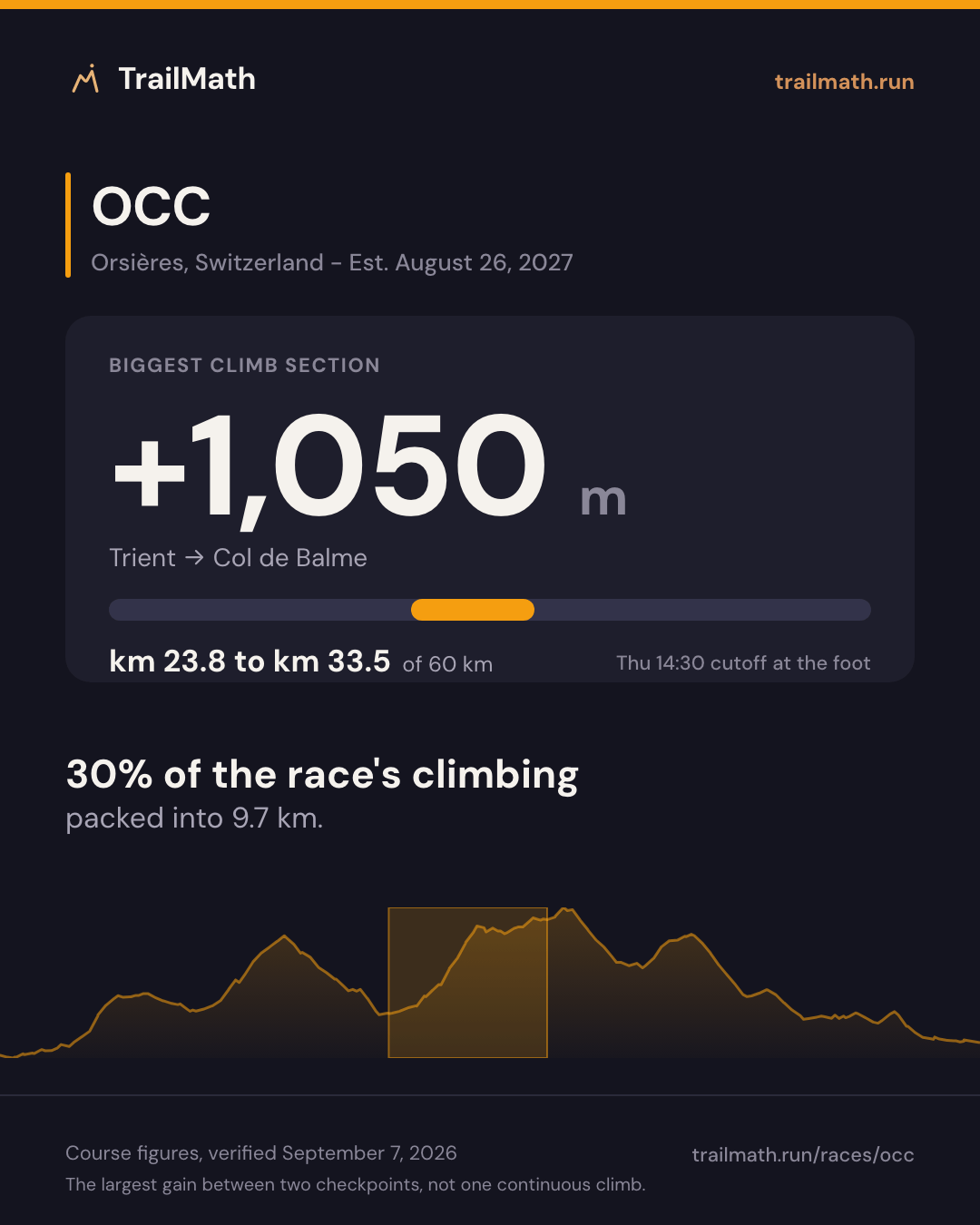
+1,050 m
Trient → Col de Balme · km 23.8–33.5
The largest gain between two checkpoints, not one continuous climb.
Trient cutoff: Thu 14:30
Plan against barriers →Biggest descent section
−650 m
Argentiere → Chamonix (Finish) · km 50.2–60
The largest loss between two checkpoints. ITRA's km-effort ignores descent; TrailMath counts it: 112 km-effort.
Open in GPX Explorer →Share this race
Cards sized for Instagram and Strava.
OCC (Orsières-Champex-Chamonix) · 2026
Finish times, 2026 edition
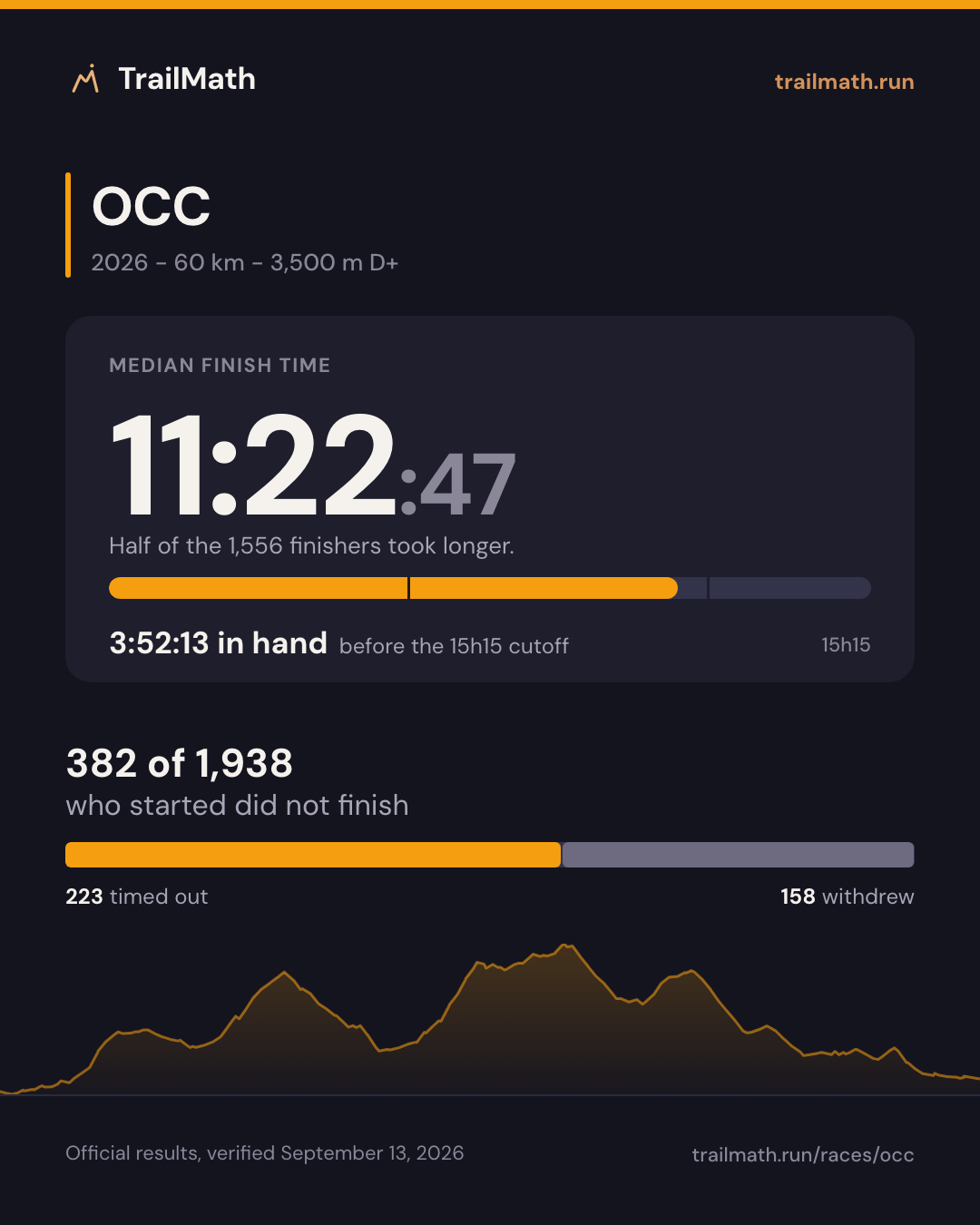
1,938 runners started. 1,556 came back. Half of them took longer than 11:22:47. That left the median finisher 3:52:13 inside the 15h15 cutoff.
Median finish
11:22:47
Half of the 1,556 finishers were still out there at this point.
3:52:13 in hand before the 15h15 cutoff
Average 11:07:26, 0:15:21 quicker than the median: a fast front pulls it down.
The start line
80.3%
1,556 of 1,938 starters made it; 382 did not.
still moving when a cutoff closed
stopped by choice or by the medics
Organisation stops and disqualifications: 1.
Men and women
Two medians on the same scale. The bars run from the start to the cutoff, so the gap between them is the gap in time.
Men
11:09:39
median finish; average 10:58:32
1,058 finishers, 68% of the field
Women
11:48:34
median finish; average 11:26:21
498 finishers, 32% of the field
0:38:55 separates the two medians, across 1,058 men and 498 women.
Finish time by age group
Every track runs from the start to the 15h15 cutoff, so the empty part of a bar is the time that group's median finisher still had. Men and women are drawn on the same scale.
| Age | Median finish | Median against the cutoff | Finishers |
|---|---|---|---|
| 20-34 | 9:38:21 | 294 | |
| 35-39 | 10:49:13 | 202 | |
| 40-44 | 11:15:57 | 158 | |
| 45-49 | 12:15:44 | 162 | |
| 50-54 | 11:58:00 | 118 | |
| 55-59 | 12:45:41 | 75 | |
| 60-64 | 13:00:00 | 28 | |
| 65-69 | 13:50:52 | 17 - small sample, read with care | |
| 70-74 | 11:35:01 | 3 - small sample, read with care | |
| 75-79 | - | 1 - too few finishers to publish a time |
| Age | Median finish | Median against the cutoff | Finishers |
|---|---|---|---|
| 20-34 | 10:27:43 | 148 | |
| 35-39 | 11:21:24 | 96 | |
| 40-44 | 11:58:06 | 87 | |
| 45-49 | 12:22:44 | 68 | |
| 50-54 | 13:01:00 | 59 | |
| 55-59 | 13:23:15 | 28 | |
| 60-64 | 13:52:43 | 11 - small sample, read with care | |
| 65-69 | - | 1 - too few finishers to publish a time |
Full bar: 20 finishers or more. Tick alone: fewer than 20, too few for a median to say much. The shaded row is the biggest group.
Where the finishers came from
24% of the finishers came from France alone.
| Nation | Finishers | Share |
|---|---|---|
| France FR | 378 24.3% | |
| Spain ES | 130 8.4% | |
| China CN | 110 7.1% | |
| United States US | 84 5.4% | |
| Italy IT | 77 4.9% | |
| United Kingdom GB | 75 4.8% | |
| Argentina AR | 60 3.9% | |
| Switzerland CH | 49 3.1% | |
| Australia AU | 41 2.6% | |
| Germany DE | 37 2.4% | |
| Poland PL | 36 2.3% | |
| Belgium BE | 33 2.1% | |
| Hong Kong SAR China HK | 27 1.7% | |
| Brazil BR | 26 1.7% | |
| Portugal PT | 22 1.4% | |
| Mexico MX | 21 1.3% | |
| Thailand TH | 21 1.3% | |
| Romania RO | 16 1.0% | |
| Austria AT | 15 1.0% | |
| Canada CA | 15 1.0% | |
| Czechia CZ | 15 1.0% | |
| Japan JP | 15 1.0% | |
| South Korea KR | 15 1.0% | |
| Malaysia MY | 13 0.8% | |
| Sweden SE | 13 0.8% | |
| Chile CL | 12 0.8% | |
| Türkiye TR | 12 0.8% | |
| Ecuador EC | 11 0.7% | |
| Norway NO | 10 0.6% | |
| Ireland IE | 9 0.6% | |
| New Zealand NZ | 8 0.5% | |
| Slovenia SI | 8 0.5% | |
| Uruguay UY | 8 0.5% | |
| Colombia CO | 7 0.4% | |
| Hungary HU | 7 0.4% | |
| Taiwan TW | 7 0.4% | |
| Andorra AD | 6 0.4% | |
| Costa Rica CR | 6 0.4% | |
| Finland FI | 6 0.4% | |
| Netherlands NL | 6 0.4% | |
| Peru PE | 6 0.4% | |
| Ukraine UA | 6 0.4% | |
| South Africa ZA | 6 0.4% | |
| Denmark DK | 5 0.3% | |
| Iceland IS | 5 0.3% | |
| Singapore SG | 5 0.3% | |
| Curaçao AN | 4 0.3% | |
| Bulgaria BG | 4 0.3% | |
| Greece GR | 4 0.3% | |
| Lithuania LT | 4 0.3% | |
| Slovakia SK | 4 0.3% | |
| Vietnam VN | 4 0.3% | |
| Cyprus CY | 2 0.1% | |
| Latvia LV | 2 0.1% | |
| Philippines PH | 2 0.1% | |
| Pakistan PK | 2 0.1% | |
| Serbia RS | 2 0.1% | |
| Bhutan BT | 1 0.1% | |
| Dominican Republic DO | 1 0.1% | |
| Estonia EE | 1 0.1% | |
| Egypt EG | 1 0.1% | |
| Honduras HN | 1 0.1% | |
| Indonesia ID | 1 0.1% | |
| Israel IL | 1 0.1% | |
| India IN | 1 0.1% | |
| Iran IR | 1 0.1% | |
| Kenya KE | 1 0.1% | |
| Kuwait KW | 1 0.1% | |
| Kazakhstan KZ | 1 0.1% | |
| Luxembourg LU | 1 0.1% | |
| Morocco MA | 1 0.1% | |
| Mongolia MN | 1 0.1% | |
| Macao SAR China MO | 1 0.1% | |
| Nicaragua NI | 1 0.1% | |
| Palestinian Territories PS | 1 0.1% | |
| Paraguay PY | 1 0.1% | |
| Qatar QA | 1 0.1% | |
| Saudi Arabia SA | 1 0.1% | |
| Venezuela VE | 1 0.1% | |
| 69 other nations 59 other nations 49 other nations 39 other nations 29 other nations 19 other nations 9 other nations | 515 33.1% 283 18.2% 158 10.2% 89 5.7% 40 2.6% 19 1.2% 9 0.6% |















































































Showing 20 of 79 nations. Showing 30 of 79 nations. Showing 40 of 79 nations. Showing 50 of 79 nations. Showing 60 of 79 nations. Showing 70 of 79 nations. Showing 79 of 79 nations.
Bar length is against the largest nation. The smallest counts are drawn at a minimum visible width, so their bars are not to scale.
How these numbers were computed
These are times for runners who finished. They exclude everyone who started and did not, so they describe how long finishing took, not how long the race takes. Bands with only a handful of finishers move a lot from one edition to the next.
We plot the median, not the average. A handful of very quick runners drags the average well below the time half the field actually beat, so the median is the honest number to plan against.
Nationality here shows who travels to this race, not who runs it best. That alone is why a host nation tops almost every list.
Computed from the full official results, verified September 13, 2026 - Official results
Ask the course
Ask OCC anything about climbs, pacing, crew or cutoffs.
Answers come from this course's data, your plan and your training.
Which climb should I respect most?
Trient to Col de Balme: +1,050 m over 9.7 km, from km 23.8. Hike the steep sections at an effort you could hold for hours - the race is decided after this climb, not on it.
Where can my crew meet me?
Champex-Lac, km 7.3 - the first of 5 crew points. The next is La Giete, km 18.6. Have them bring warm layers: the course tops out at 2,321 m, in August.
Is 11h a realistic finish for me?
11h would put you in the faster half of 2026 finishers - the median was 11:22:47. It means holding 11:00/km overall.
The assistant answers that once it can see your training.
Build your OCC plan and your question is the first thing waiting in the TrailMath Assistant. Your first 5 questions are free, no card.
Build my OCC plan14 days of Premium included.
To answer this for you, the Course Assistant uses your training and your race plan.
Example answer
Your long runs peak at 20 km, so the plan builds to 4-hour long runs. Cutoff buffer at Col de Balme: 3h08.
14 days of Premium included.
Try asking OCC
Ask anything - we'll open your OCC plan with your question ready.
Loading the Course Assistant
See your training shape
Pick your weekly volume and training days to preview the plan structure - no account needed.
~46 weeks · peak ~8 h/week · 5 run + 2 strength days
For a 60 km race, aim for about 8 h/week at peak. Set your availability to 9 h/week in the app for the headroom to build there gradually.
Typical structure for your volume - your live plan adjusts sessions inside each week.
Make this your plan
Create your free account to generate the full week-by-week plan and keep it on track as your season changes.
Aid stations and checkpoints
| Checkpoint | Km | Cumulative gain (m) | Cumulative loss (m) | Cutoff |
|---|---|---|---|---|
| Start - Orsieres Services not published | 0 | 0 | 0 | - |
| Champex-Lac Crew | 7.3 | 620 | 70 | - |
| Plan de l'Au | 12.2 | 680 | 260 | Thu 11:30 |
| La Giete Crew | 18.6 | 1,410 | 440 | - |
| Trient Crew | 23.8 | 1,460 | 1,060 | Thu 14:30 |
| Col de Balme | 33.5 | 2,510 | 1,220 | Thu 17:45 |
| Tete de Balme Services not published | 35.2 | 2,630 | 1,240 | - |
| Col des Posettes Services not published | 41.8 | 2,940 | 1,860 | - |
| Le Tour Crew | 46.8 | 3,010 | 2,450 | - |
| Argentiere Crew | 50.2 | 3,070 | 2,730 | Thu 21:15 |
| Chamonix (Finish) Crew | 60 | 3,500 | 3,380 | Thu 23:30 |
Data is approximate and courses change between editions - always verify against the official race guide. Source: official race guide, verified September 7, 2026 - Official race website
FAQ
How long is the OCC?
The OCC covers approximately 60km from Orsieres (Switzerland) through Champex-Lac and Trient to Chamonix (France), with around 3,500m of cumulative elevation gain.
How much elevation gain does the OCC have?
The OCC has around 3,500m of cumulative elevation gain over 60km, with the biggest climb rising from Trient to the Col de Balme and the Tete de Balme high point.
What is the cutoff time for the OCC?
The overall OCC cutoff is 15 hours 15 minutes, from the first wave at 08:15 to the finish barrier at 23:30. Later waves start behind the first, so each runner has that much less. Intermediate barriers apply at Plan de l'Au, Trient, Col de Balme, and Argentiere, and winning times are typically around 5 hours.
What is the highest point of the OCC?
The highest point of the 2026 OCC course is the Tete de Balme at 2,321m, a new passage between the Col de Balme and the Col des Posettes introduced with the 2026 course redesign.
How many aid stations does the OCC have and which allow crew?
The checkpoint table lists 9 major aid points between Orsieres and the finish in Chamonix. Crew access is allowed at Champex-Lac (7.3km), La Giete (18.6km), Trient (23.8km), Le Tour (46.8km), and Argentiere (50.2km).
Training for this race?
TrailMath builds periodized trail training plans around your goal race.
One Strava connection reads your last 90 days and estimates your finish on this course. Free, no plan needed.