Western States 100 - Elevation Profile, Aid Stations and Cutoffs
- Olympic Valley, California, USA
- 161 km
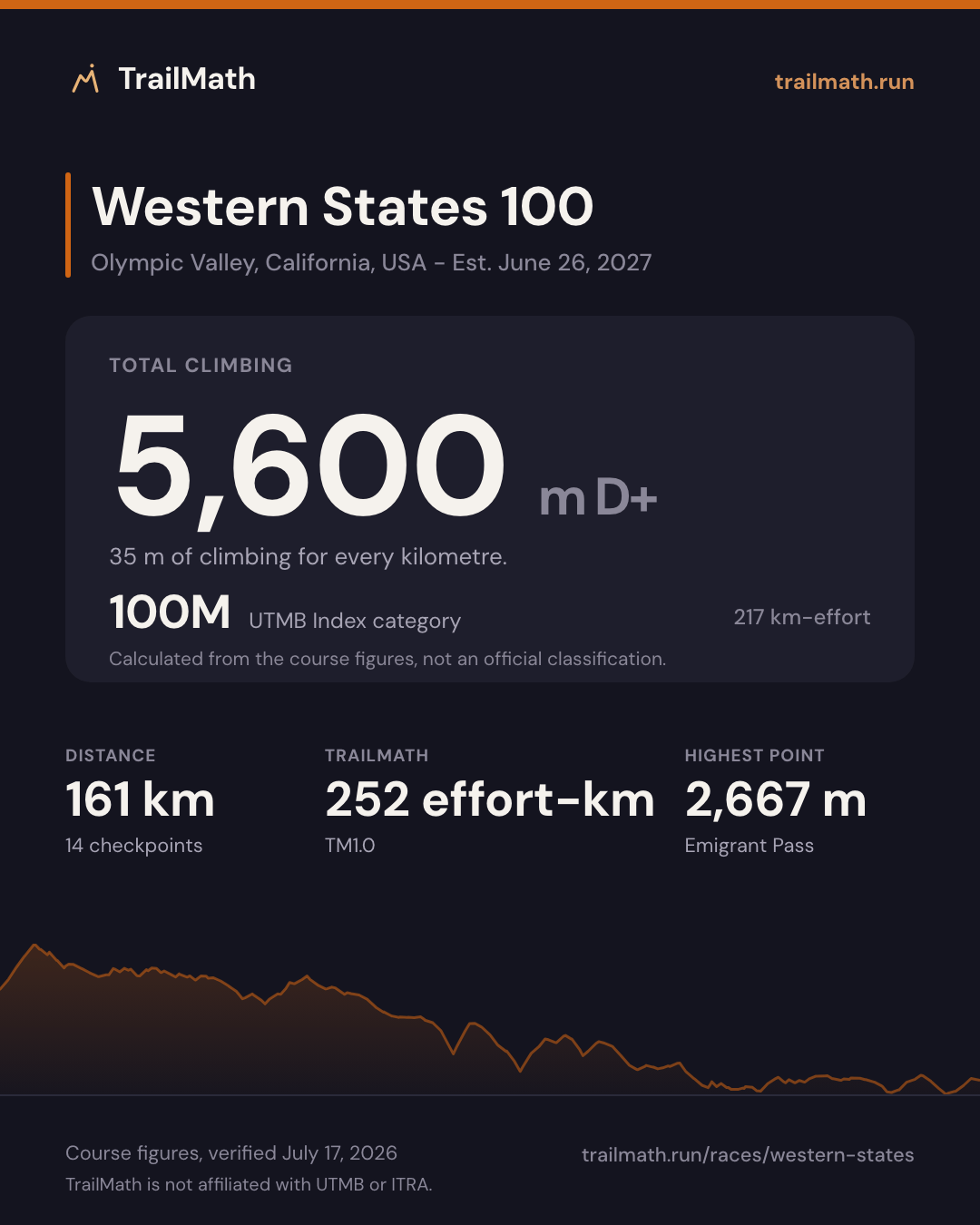
- 5,600 m D+
- 12 aid stations
Map, checkpoints and cutoffs Map · checkpoints · forecast opens Jun 17 Race-day forecast is live
Race-day conditions
Weather, daylight and your arrival time at all 14 checkpoints, set to the 05:00 start.
- Start
- 05:00
- Daylight at the start
- 05:35-20:31
- Aid stations
- 12
Course profile
Olympic Valley, California, USA
- Distance
- 161 km Finishes 1,400 m lower than it starts
- Elevation
- +5,600 m -7,000 m About 35 m of climb per km
- Highest point
- 2,667 m Emigrant Pass
Next edition Est. Sat 26 Jun 2027
Our estimate for Sat 26 Jun 2027. The organiser has not announced the date for this race yet.
- Start
- Sunrise 0h40 after the start
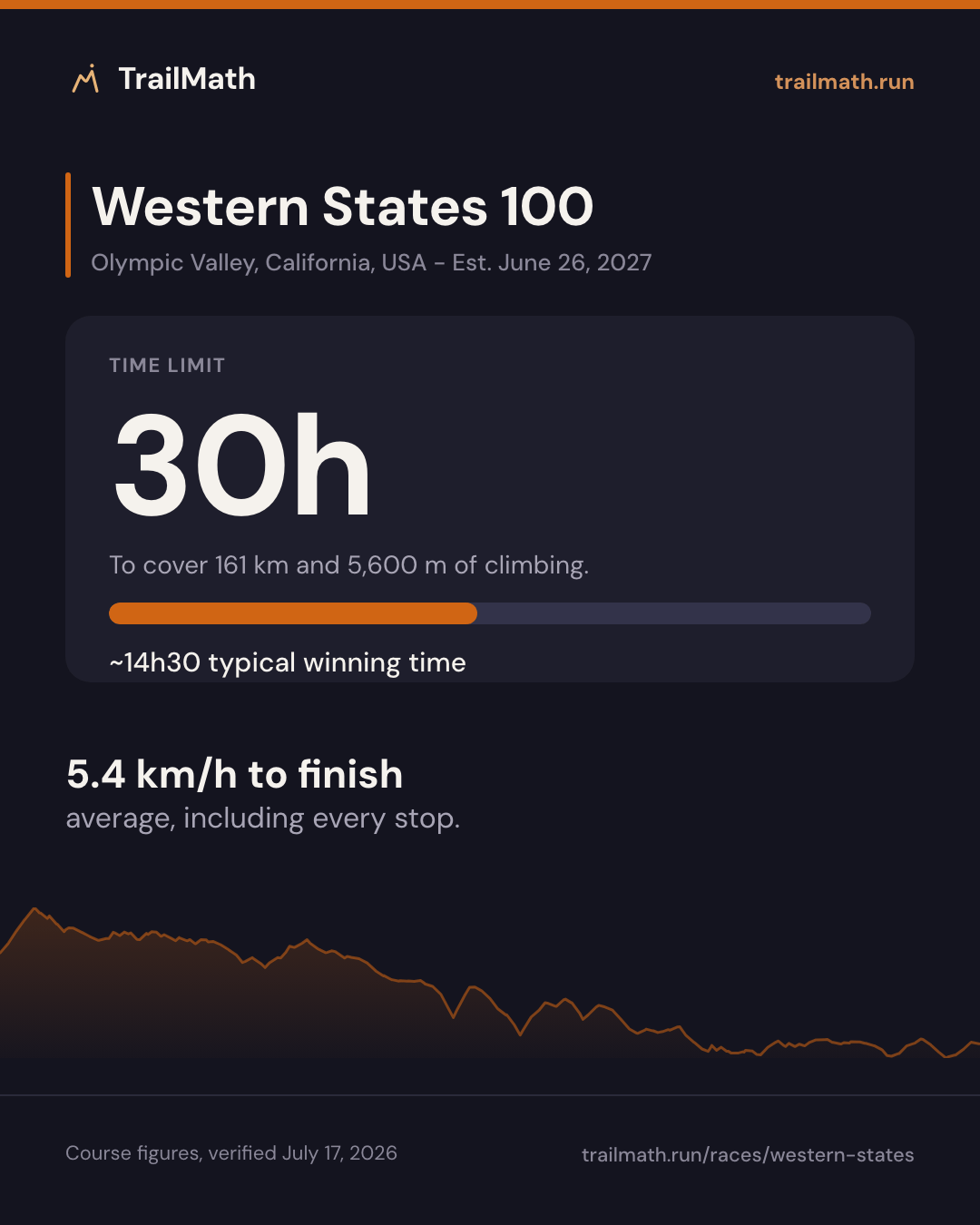
- Winner ~14h30 14h30 after the start
- Sunset 15h33 after the start
- Median finisher 25h42 after the start
- Cutoff 30h after the start
A median finisher runs 9h47 in the dark.
The Western States 100-Mile Endurance Run covers 161km from Olympic Valley to Auburn, California, with around 5,600m of elevation gain and 7,000m of loss. The cutoff is 30 hours, and the highest point is Emigrant Pass at 2,667m, reached in the opening climb. First run in 1974, it is the world's oldest 100-mile trail race.
After the opening climb to the Escarpment, the course trends downhill through the Sierra Nevada high country into the canyons, where afternoon temperatures regularly reach 35-40°C between Devil's Thumb and Foresthill. Robinson Flat, Michigan Bluff, Foresthill, and Rucky Chucky are the key crew points; the river crossing at Rucky Chucky (km 122) is the iconic landmark of the final third.
Data is approximate and courses change between editions - always verify against the official race guide.
Plan against the cutoffs
Enter a goal finish time and see estimated arrivals vs checkpoint cutoffs.
Estimate your finish
One Strava connection reads your last 90 days and estimates your finish on this course. Free, no plan needed.


Course math
Four numbers worked out from this course's distance, elevation and checkpoints.
TrailMath effort-km
252 effort-km
About 28 h for a mid-pack finisher (index 500). Not a pacing guarantee.
Distance + gain ÷ 100 + loss ÷ 200, beside ITRA's gain-only km-effort. Model TM1.0.
How TrailMath works →UTMB Index category
100M
217 km-effort (distance + gain ÷ 100). Calculated from the course figures, not an official classification.
Estimate your UTMB Index →Biggest climb section
+900 m
Olympic Valley → Lyon Ridge · km 0–15
The largest gain between two checkpoints, not one continuous climb.
Biggest descent section
−1,700 m
Robie Point → Auburn (Finish) · km 158–161
The largest loss between two checkpoints. ITRA's km-effort ignores descent; TrailMath counts it: 252 km-effort.
Open in GPX Explorer →Share this race
Cards sized for Instagram and Strava.
See your training shape
Pick your weekly volume and training days to preview the plan structure - no account needed.
~37 weeks · peak ~8 h/week · 5 run + 2 strength days
For a 161 km race, aim for about 12 h/week at peak. Set your availability to 14 h/week in the app for the headroom to build there gradually.
Typical structure for your volume - your live plan adjusts sessions inside each week.
Make this your plan
Create your free account to generate the full week-by-week plan and keep it on track as your season changes.
Aid stations and checkpoints
| Checkpoint | Km | Cumulative gain (m) | Cumulative loss (m) | Cutoff |
|---|---|---|---|---|
| Start - Olympic Valley Services not published | 0 | 0 | 0 | - |
| Lyon Ridge | 15 | 900 | 200 | Sat 10:30 |
| Red Star Ridge Drop bag | 27 | 1,400 | 800 | Sat 10:30 |
| Duncan Canyon | 37 | 1,800 | 1,500 | Sat 12:30 |
| Robinson Flat Crew Drop bag | 55 | 2,700 | 1,800 | Sat 14:10 |
| Last Chance | 73 | 3,000 | 2,700 | Sat 17:25 |
| Devil's Thumb | 78 | 3,700 | 2,700 | Sat 19:10 |
| Michigan Bluff Crew Drop bag | 88 | 3,700 | 3,500 | Sat 21:55 |
| Foresthill Crew Drop bag | 97 | 4,100 | 3,600 | Sat 23:45 |
| Rucky Chucky Crew | 122 | 4,300 | 4,500 | Sun 05:00 |
| Auburn Lake Trails Crew | 130 | 4,700 | 4,700 | Sun 07:15 |
| No Hands Bridge | 143 | 4,800 | 5,200 | - |
| Robie Point Crew | 158 | 5,100 | 5,300 | Sun 11:00 |
| Auburn (Finish) Crew | 161 | 5,600 | 7,000 | Sun 11:00 |
Data is approximate and courses change between editions - always verify against the official race guide. Source: official race guide, verified July 17, 2026 - Official race website
FAQ
How long is Western States?
Western States is 100.2 miles (approximately 161km), point to point from Olympic Valley to Auburn, California.
How much elevation gain does Western States 100 have?
Western States has around 5,600m (roughly 18,000ft) of elevation gain and 7,000m (roughly 23,000ft) of loss over 161km - a net downhill course.
What is the cutoff time for Western States?
The final cutoff is 30 hours. Runners finishing under 24 hours earn the silver buckle; finishers under 30 hours earn the bronze buckle. Winning times are typically around 14-15 hours.
What is the highest point of Western States?
The highest point is Emigrant Pass at 2,667m (8,750ft), reached at the top of the opening climb from Olympic Valley, about 6km into the race.
How many aid stations does Western States have and which allow crew?
The checkpoint table lists 12 major aid points between the start and the finish in Auburn. Crew access is allowed at Robinson Flat (55km), Michigan Bluff (88km), Foresthill (97km), Rucky Chucky (122km), Auburn Lake Trails (130km), and Robie Point (158km). Drop bags are allowed at several checkpoints - check the current runner guide at wser.org.
Training for this race?
TrailMath builds periodized trail training plans around your goal race.
One Strava connection reads your last 90 days and estimates your finish on this course. Free, no plan needed.