SallandTrail - 100 km - Elevation Profile, Aid Stations and Cutoffs
- Het Ravijn, Nijverdal, Netherlands
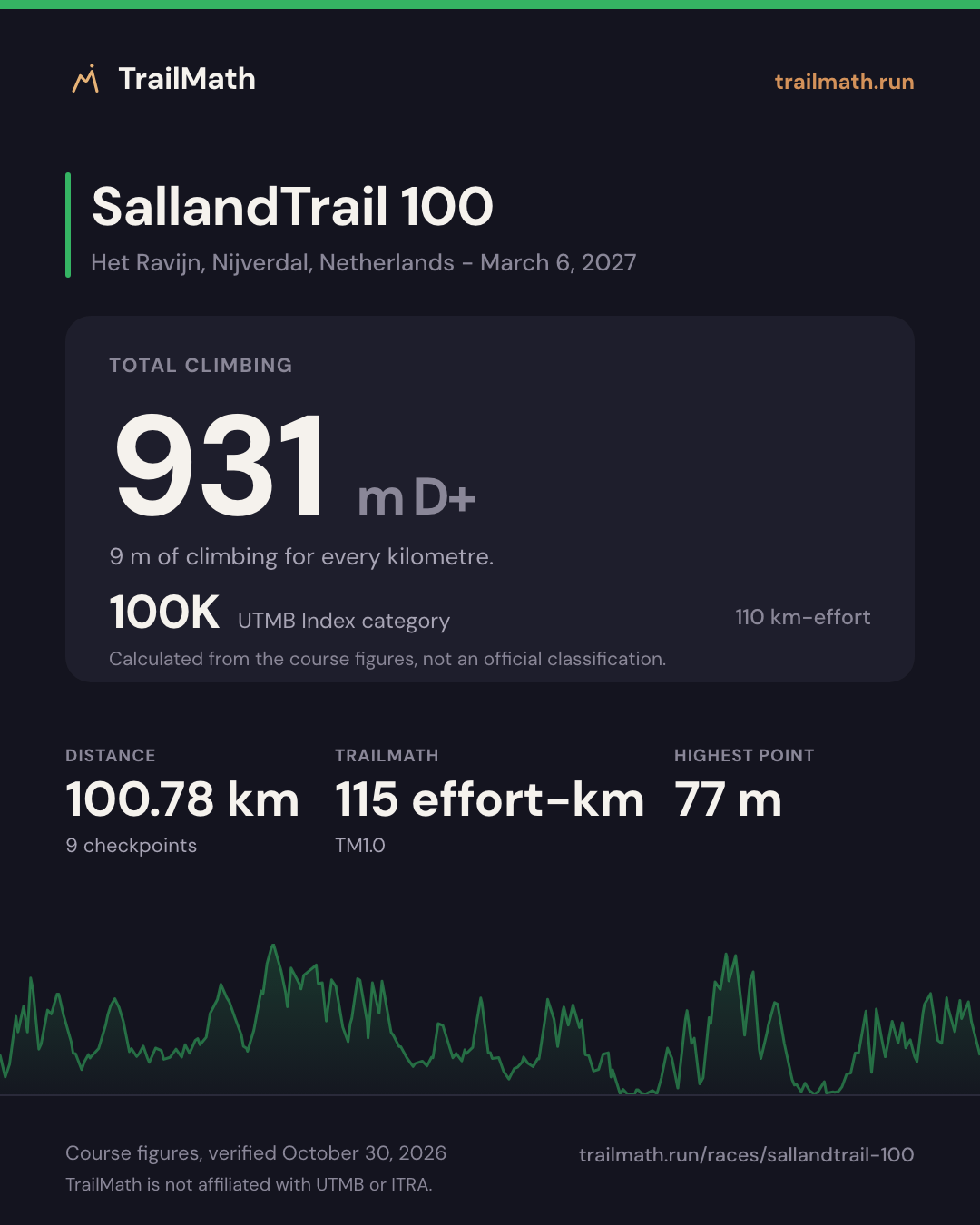
- 100.8 km
- 931 m D+
- 7 aid stations
Map, profile and checkpoints Map · checkpoints · forecast opens Feb 25 Race-day forecast is live
Race-day conditions
Weather, daylight and your arrival time at all 9 checkpoints, set to the 05:00 start.
- Start
- 05:00
- Daylight at the start
- 07:10-18:21
- Aid stations
- 7
Course profile
Het Ravijn, Nijverdal, NetherlandsHet Ravijn, Nijverdal, Netherlands· point-to-point
- Distance
- 100.78 km
- Elevation
- +931 m-931 mAbout 9 m of climb per km
- Highest point
- 77 m
Next editionSat 6 Mar 2027 · 05:00
- Start
- SunriseHet Ravijn, Nijverdal, Netherlands2h11 after the start
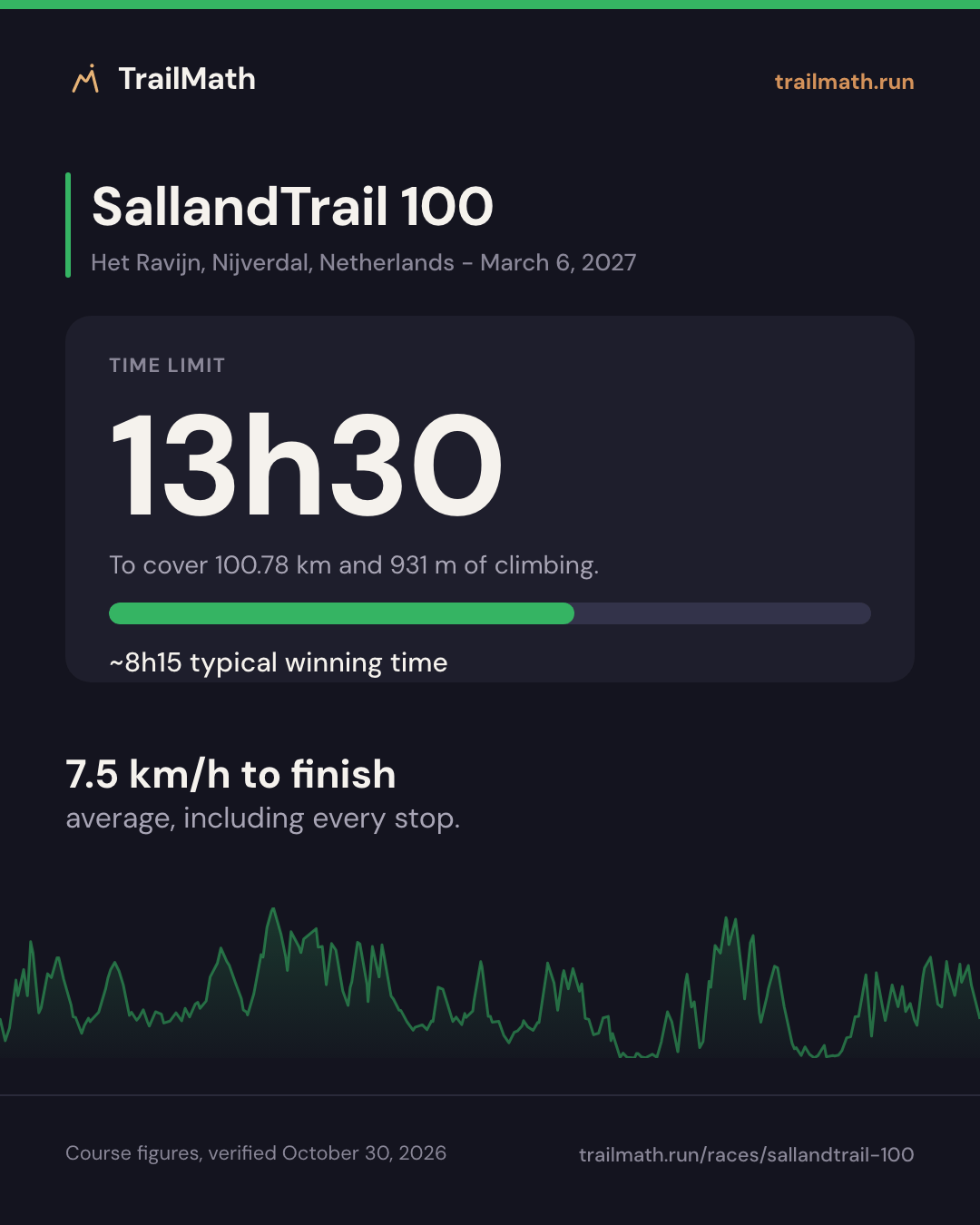
- Winner~8h158h15 after the start
- Median finisher2026 median9h50 after the start
- SunsetHet Ravijn, Nijverdal, Netherlands13h21 after the start
- Cutoff13h30 after the start
A median finisher runs 2h11 in the dark.
SallandTrail - 100 km is a 100.78 km ultra-trail with around 931 m of elevation gain, starting in Het Ravijn, Nijverdal, Netherlands. The overall cutoff is 13 hours 30 minutes. That is 9 m of climbing per kilometre. SallandTrail has 5 races, from 42.39 to 100.78 km; this one ranks 1 of 5 by distance and 5 of 5 by climbing per kilometre.
The steepest sustained section on the elevation profile averages about 2% over roughly 2.2 km around km 74. The published checkpoint list has no crew-access points - check the official runner guide for assistance rules.
Data is approximate and courses change between editions - always verify against the official race guide.
Other distances at SallandTrail
| Race | Distance | D+ | Cutoff | Next start |
|---|---|---|---|---|
| SallandTrail 100 (this page) | 100.8 km | 931 m | 13h30 | Mar 6, 2027 |
| SallandTrail 80 | 80.8 km | 820 m | 13h00 | Mar 6, 2027 |
| SallandTrail 60 | 60 km | 588 m | 10h30 | Mar 6, 2027 |
| SallandTrail 50 | 51.4 km | 524 m | 10h10 | Mar 6, 2027 |
| SallandTrail 42 | 42.4 km | 418 m | 8h00 | - |
Plan against the cutoffs
Enter a goal finish time and see estimated arrivals vs checkpoint cutoffs.
Estimate your finish
One Strava connection reads your last 90 days and estimates your finish on this course. Free, no plan needed.


Course math
Four numbers worked out from this course's distance, elevation and checkpoints.
TrailMath effort-km
115 effort-km
About 10 h for a mid-pack finisher (index 500). Not a pacing guarantee.
Distance + gain ÷ 100 + loss ÷ 200, beside ITRA's gain-only km-effort. Model TM1.0.
How TrailMath works →UTMB Index category
100K
110 km-effort (distance + gain ÷ 100). Calculated from the course figures, not an official classification.
Estimate your UTMB Index → ITRA and UTMB indexes explainedShare this race
Cards sized for Instagram and Strava.
SallandTrail - 100 km · 2026
Finish times, 2026 edition
29 runners finished. Half of them took longer than 9:50:24.
Median finish
9:50:24
Half of the 29 finishers were still out there at this point.
The start line
Men and women
Two medians on the same scale. The bars run from the start to the cutoff, so the gap between them is the gap in time.
Men
9:50:24
median finish; average 9:51:51
27 finishers, 93% of the field
Women
9:36:27
median finish; average 9:45:02
2 finishers, 7% of the field
0:13:57 separates the two medians, across 27 men and 2 women.
Where the finishers came from
93% of the finishers came from Netherlands alone.
| Nation | Finishers | Share |
|---|---|---|
| NetherlandsNL | 2793.1% | |
| AustriaAT | 13.4% | |
| GermanyDE | 13.4% |
Bar length is against the largest nation. The smallest counts are drawn at a minimum visible width, so their bars are not to scale.
How these numbers were computed
These are times for runners who finished. They exclude everyone who started and did not, so they describe how long finishing took, not how long the race takes. Bands with only a handful of finishers move a lot from one edition to the next.
We plot the median, not the average. A handful of very quick runners drags the average well below the time half the field actually beat, so the median is the honest number to plan against.
Nationality here shows who travels to this race, not who runs it best. That alone is why a host nation tops almost every list.
Computed from the full official results, verifiedOctober 30, 2026 - Official results
Ask the course
Ask SallandTrail 100 anything about climbs, pacing, crew or cutoffs.
Answers come from this course's data, your plan and your training.
Where can my crew meet me?
Holten - Nijverdalseweg, km 16.6 - your first checkpoint, and no crew can meet you there or further on: the organiser lists no crew access on SallandTrail 100.
Is 9h a realistic finish for me?
9h would put you in the faster half of 2026 finishers - the median was 9:50:24. It means holding 5:21/km overall.
The assistant answers that once it can see your training.
Build your SallandTrail 100 plan and your question is the first thing waiting in the TrailMath Assistant. Your first 5 questions are free, no card.
Build my SallandTrail 100 plan14 days of Premium included.
To answer this for you, the Course Assistant uses your training and your race plan.
Example answer
Your long runs peak at 30 km, so the plan builds to 4-hour long runs.
14 days of Premium included.
Try asking SallandTrail 100
Ask anything - we'll open your SallandTrail 100 plan with your question ready.
Loading the Course Assistant
See your training shape
Pick your weekly volume and training days to preview the plan structure - no account needed.
~19 weeks · peak ~8 h/week · 5 run + 2 strength days
For a 100.78 km race, aim for about 12 h/week at peak. Set your availability to 14 h/week in the app for the headroom to build there gradually.
Typical structure for your volume - your live plan adjusts sessions inside each week.
Make this your plan
Create your free account to generate the full week-by-week plan and keep it on track as your season changes.
Aid stations and checkpoints
| Checkpoint | Km | Cumulative gain (m) | Cumulative loss (m) |
|---|---|---|---|
| Start - Het Ravijn | 0 | 0 | 0 |
| Holten - Nijverdalseweg | 16.6 | 146 | 141 |
| Holten | 31.74 | 268 | 228 |
| Haarle | 43.91 | 375 | 379 |
| Berghuizen | 55.81 | 447 | 441 |
| Lemele | 68 | 526 | 536 |
| Lemele (second pass) | 81.38 | 722 | 731 |
| Kathuizen | 89.46 | 781 | 780 |
| Finish - Het Ravijn | 100.78 | 931 | 931 |
Data is approximate and courses change between editions - always verify against the official race guide. Source: official race guide, verifiedOctober 30, 2026 - Official race website
FAQ
How much elevation gain does SallandTrail - 100 km have?
SallandTrail - 100 km has around 931 m of cumulative elevation gain and 931 m of loss over 100.78 km.
What is the cutoff time for SallandTrail - 100 km?
The overall SallandTrail - 100 km cutoff is 13 hours 30 minutes, with intermediate time barriers at major checkpoints. Winning times are typically around 8 hours.
How long is SallandTrail - 100 km?
SallandTrail - 100 km covers approximately 100.78 km, starting in Het Ravijn, Nijverdal, Netherlands.
How many aid stations does SallandTrail - 100 km have and which allow crew?
The checkpoint table lists 7 major aid points between the start and the finish. Personal crew assistance is not part of the published checkpoint data - check the official runner guide.
Training for this race?
TrailMath builds periodized trail training plans around your goal race.
One Strava connection reads your last 90 days and estimates your finish on this course. Free, no plan needed.